Parkland mammogram leads to early breast cancer diagnosis
Mobile screening helped identify stage 1 triple-negative breast cancer
Ann Harrington almost didn’t show up for the mammogram that would save her life.
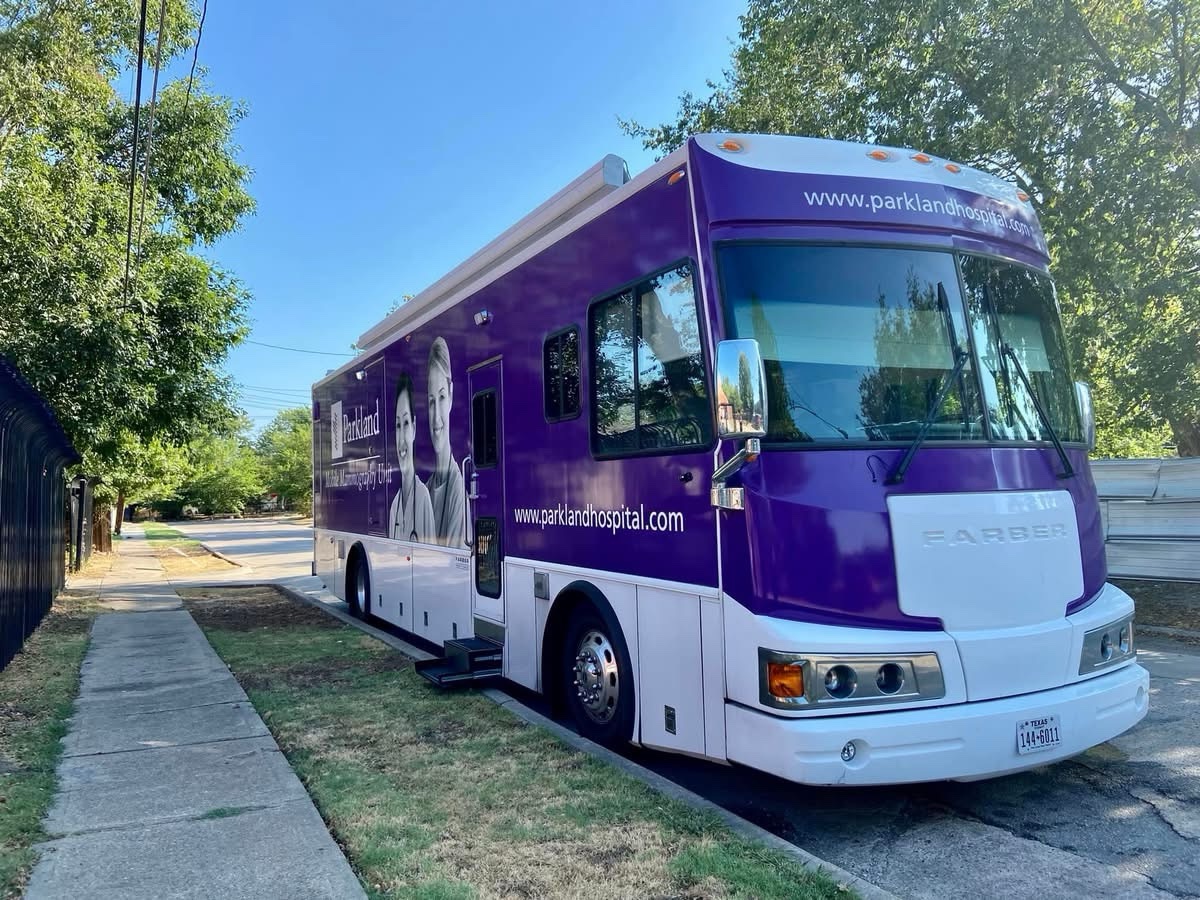
On August 13, 2022, she was busy preparing for an upcoming trip to Jamaica with her sisters, and her appointment for a free screening with Parkland Health’s Mobile Mammography Unit at Voice of Hope Ministries in West Dallas had slipped to the bottom of her to-do list.
But Parkland Community Development Specialist Jeff Howard noticed she was a no-show. He knew Harrington through her work as a community volunteer and encouraged her to come.
Harrington told him she was busy and planned to skip the appointment, but Howard persisted: “I think it’s important that you come in. Please come in.”
Debbie Solis, Director of Family & Community Services at Voice of Hope, also called Harrington and told her, “I already have your paperwork, I already told them you’re coming—so you just show up.”
Harrington, then 45, finally agreed. She did not have health insurance at the time, making access to the free screening especially important. She recalled that the experience on the mobile unit was “just like I was at a hospital” and was “quick and easy.”
After four prior mammograms with no problems, she expected the same outcome. Instead, the screening detected an abnormality. A biopsy later confirmed stage 1 triple-negative breast cancer, a fast-growing form of cancer. She said she had never felt a lump.
Parkland uses its Community Health Needs Assessment to help identify communities where the mobile unit can reach women who may face barriers to breast cancer screening. Howard helped coordinate the 2022 event in the 75212 ZIP Code in West Dallas, near Parkland’s deHaro-Saldivar Health Center.
When Howard learned Harrington was the one person whose screening at the event led to an abnormal finding, he immediately helped connect her with follow-up diagnostic care.
“For me, this was the first time that I’d ever had someone test positive for breast cancer at one of my events,” Howard recalled. “I wanted to make sure, number one, she got the treatment that she needed, and number two, that we were able to get her in quickly for treatment. And as it turns out, that made the difference.”
Breast cancer survivor Ann Harrington is pictured with Parkland Community Development Specialist Jeff Howard and Debbie Solis, Director of Family & Community Services at Voice of Hope.
After Harrington’s diagnosis, plenty of people had opinions about where she should seek treatment. But Harrington recalled how her family always went to Parkland for care.
“My aunt always told me, no matter what, go to Parkland,” Harrington said.
In September 2022, she had her first appointment in the Moody Center for Breast Health at Parkland. The following month, she underwent surgery to have the tumor removed from her right breast, followed by chemotherapy.
Chemotherapy made Harrington sick and caused her to lose her hair. Her daughter cut off her own hair in support. On Harrington’s birthday, Dec. 27, 2022, she felt so ill that her celebration lasted only about an hour.
Harrington was depressed and at times angry about her diagnosis. Her care team connected her with a support group and one-on-one counseling at Moody, where she appreciated having her treatment and support services in one place.
In the support group, Harrington said, “We all kind of encouraged each other. I do feel like that’s very important.” She remains in touch with other women in her group.
She remembers her doctor and care team encouraging her through difficult moments: “When I cried, I remember, they always told me, ‘you got this.’”
She now wears a necklace bearing those words and gives similar necklaces to friends diagnosed with or impacted by breast cancer.
Harrington also remembers the support she received from Julie Dreadin, DNP, WHNP-BC, AOCNP, an Advanced Practice Provider in Parkland’s Oncology Clinic, who recalls Harrington’s anxiety as she underwent treatment.
“You just have to provide a lot of reassurance and sometimes just talk about all the research on breast cancer and all the options there are to treat it,” Dreadin recalled. “We try to be very available to talk to patients if there is a concern or worry.”
On March 7, 2023, Harrington completed chemotherapy, rang a bell in celebration, and then danced in a hallway with her care team. Two weeks later, she posed triumphantly in a pink dress with large dangling pink ribbon earrings and carried a sign at a breast cancer awareness walk declaring, “I’m walking all over cancer.” She later completed radiation treatment.
Harrington now shares information about free Parkland mobile mammography screenings on social media whenever she can, especially with women who do not have health insurance. She remembers how close she came to skipping her own appointment because her prior four mammograms, beginning at age 40, had been clear.
“I like to tell everyone, never miss a mammogram,” she said. “A lot of people think they can miss it, you know, and that’s exactly what I was thinking—I’m just going to miss this, everything’s been perfect.”
She even designed a virtual billboard that is now her Facebook cover photo. The image depicts her wearing pink and declaring the message, “Mammograms are important. Don’t miss a check up!”
Harrington now returns regularly to Parkland for follow-up care and screenings. She considers it a “blessing” that free mammograms are available to women who qualify.
Solis is thankful to have Parkland nearby. “West Dallas is so close to Parkland and if there’s a need, we know Parkland will always be there,” she said.
Howard said Harrington’s cancer detection is one of the top three highlights of his more than 17-year career at Parkland. He is grateful her case did not slip through the cracks, and that he was able to help her navigate the hospital system.
“She was able to get the treatment that she needed in a timely manner, and she was able to beat the cancer,” Howard said. “For me, that’s a win, because the system worked like it should have. That was something that made me proud of what we could do at Parkland.”
Visit the Mobile Mammography Unit website for information on upcoming mammogram opportunities and how to schedule an appointment. Women who live in Dallas County, are 40 to 74 years old and have not had a mammogram in the last 12 months are eligible to schedule appointments by calling 214-266-3333.
For more information about services available at Parkland, please visit www.parklandhealth.org.
Back